Apple's week February 20: face computers & unwavering privacy
This week's newsletter is about defining the various face computers and why I believe Apple is a trustworthy privacy-first company.
With Meta in court and Zuckerberg blaming all of his problems on Apple, the discussion has shifted back to Apple's stance on privacy. People in power want to eliminate privacy in the name of saving the kids, or even pets, while everyone else knows that this isn't about saving anyone.
It's about control.
Here's the news of the week:
- No more illegal tariffs
- Apple is the only choice when it comes to privacy
- GameSir G8 Plus is a good iPad mini controller
- Zuck deflects blame to everyone but himself
- Smart glasses by Apple are coming, no HUD
- Apple's AI strategy is about useful tools that stay out of the way
- Playlist Playground is coming in iOS 26.4
- It's not an event, it's an experience
The many ways to get computers on your face
There has been some confusion around Apple and its competition when it comes to wearable face computers. I wanted to clear that up here with how I've been approaching the devices.
The categories I break them up into are:
- Totally immersive VR headset: Apple Vision Pro
- Augmented reality glasses: The futuristic AR Apple glasses
- Wearable HUD: A 2D display you wear on your face
- Smart glasses: AirPods that happen to have glasses frames
This breaks down even further. The Apple Vision Pro and Apple AR glasses are visionOS platforms. The wearable HUD and lesser smart glasses are part of the same platform, but it isn't visionOS – perhaps audioOS like HomePod (a variant of tvOS).
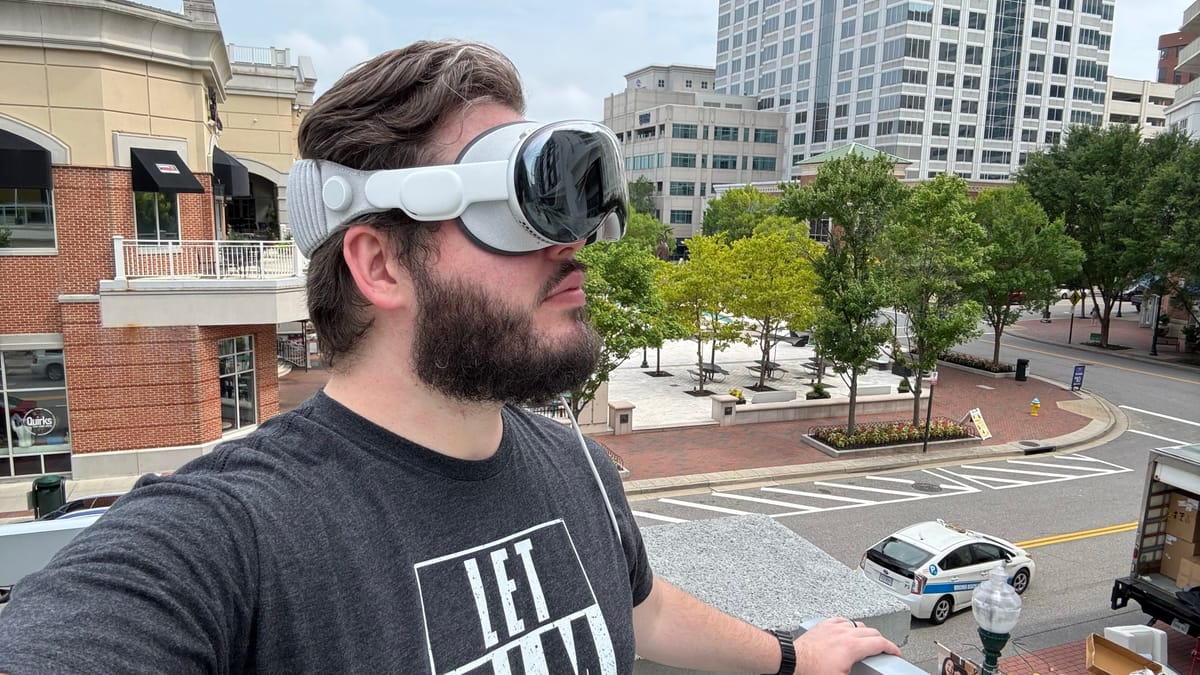
I may have just called Apple Vision Pro a VR headset, but I see it closer to mixed reality. It has an understanding of your environment like augmented reality and can place objects in a 3D space. It also has the ability to move into an immersive view that is fully virtual reality.
The key with Apple Vision Pro is that it is a display showing you the world instead of transparent glass. That's where the Apple Glass come in. This device would have all of the aspects of the AR side of Apple Vision Pro, but without the need for cameras capturing your space.
That's the sci-fi dream anyway.
The in-between is a wearable HUD, which is a natural evolution of smart glasses. The wearable HUD, much like Google Glass, is a display that can show data, but it doesn't have any depth or understanding of your space. It's literally just a monitor displaying information no different from an Apple Watch.
The smart glasses, like Meta Ray-Bans, are glasses without a display, but have microphones, speakers, and cameras. This is the product Apple is expected to launch later in 2026.
I also believe all of these rumors about "AirPods with cameras" are these glasses. Because, functionally speaking, that's what Meta Ray-Bans are.
I'm not in marketing, so I don't have a good set of fancy names to attach to these devices. Apple Vision Pro is there, so perhaps Apple Vision could be the glasses.
The smart glasses are the conundrum. Spectacles, glasses, goggles, and lenses all seem a bit silly. Apple Frames and Apple Frames Pro (with the display) perhaps?
Anyway, I hope this clears up my thinking on the matter. It also shows why I'm annoyed when people say Apple is giving up on Apple Vision Pro in pursuit of smart glasses – they're two different platforms!
iOS 26.4 beta 1 is here, but the new Apple Intelligence isn't
I've shared my various thoughts on this already, so I'll keep it short. First, we have no idea if Apple wants to bring the new AI and Siri into the beta later, or if it is waiting for iOS 26.5.
I don't think this is any indication that there's been some kind of delay or internal disaster. The rumors around a delay are flakey at best and seem to indicate the usual struggle with AI as a technology, and not some failure of Apple's.
Perhaps Apple's need for perfection is getting in their way too. The latest Upgrade podcast episode was really good for hashing this out. One of the more sane conversations in the space.
I fully expect we'll get some version of the new Apple Intelligence and Siri with personalization and app intents before WWDC. Even though it seems Apple users don't care beyond a vocal minority, it is still something the company can't keep pushing back for obvious reasons.
Let's see what they do, or don't deliver, and go from there.
Apple and privacy
People don't care about privacy. At least, not in the way I think that I do and others like me.
If you ask a person about what privacy means, they'll tell you it's a reasonable assumption that what they do isn't being seen or scrutinized by an external party. However, when you explain that almost every facet of their lives is being used to monetize the internet, they tend to shrug.
It is a similar reaction I get from people that use the same password for every account. They don't really care because it doesn't have any tangible effect on their life. At least, until it does.
I don't expect everyone to be an expert. I have a job explaining these topics to people, so I'd like to think that there's some value in that. But I do wish people cared more, because they clearly don't.
That's why I wrote my post for AppleInsider that went up earlier today on privacy. It's not about how locked down you can make your Android phone or Linux machine. It's about how Apple's default settings protect the user that otherwise doesn't care.
When you buy an iPhone, you get an end-to-end encrypted chat, phone, and video call system out of the box. Notifications tell you when an app wants your location and how it is used. The App Store says what data each app collects.
Safari actively prevents trackers from following you around the web. And Apple's list of default apps is good enough that users don't go seeking privacy-violating third-party services – usually anyway.
A single toggle can make nearly everything you do be end-to-end encrypted with Advanced Data Protection. Another toggle can make your network traffic obfuscated from apps and your service providers with iCloud Private Relay.
Google and others have followed Apple with some of these features, but due to the nature of Android and Windows, they're more bandages than actual products. And they'll only take things so far because the nature of their platforms demands that user privacy be violated. Apple's doesn't.
So when I say Apple is the most private company that we can trust with our devices and data, that's what I mean. And in this world of increasing violence and surveillance, we all need a little more privacy.